
In San Francisco, a city so awash in venture capital we'll soon need a startup just to tend to the unicorns, it's disconcerting to hear someone declare California “one of the worst business climates in the country” and exhort government to “take the foot off the neck of business.” But that was the message of Republican Assemblyman Bill Brough of Orange County at a hearing last week in San Francisco on Proposition 13.
The hearing was called by Assemblyman Phil Ting, who said one of the first things he learned upon arriving in Sacramento after his 2012 election to represent San Francisco's west side was, “The fastest way to clear a room is to talk about Prop. 13.”
That may be true in Sacramento, but the auditorium here was packed with impassioned residents prepared to weigh in on California's signature political albatross — the 1978 state constitutional amendment that turned back the clock on property values to 1975, capped property taxes at 1 percent of assessed value, and limited the increase in property value to 2 percent a year unless the property changes owners, at which point it would be reassessed.
To supporters, Prop. 13 is the only thing allowing the elderly to stay in their homes; detractors say it's the reason California's school system ranks 34 in per-pupil-spending, despite having by far the largest GDP in the nation.
Nearly 40 years after Prop. 13 forever hindered the state's ability to craft a budget, Ting has introduced a bill that would give the elephant in the statehouse a minor haircut. His proposal would close a loophole in the definition of change of ownership, in hopes of preventing fraud such as the infamous case in which the sale of One Market Plaza was hidden from the tax collector for years.
Meanwhile, state senators Loni Hancock and Holly Mitchell have introduced a constitutional amendment that would radically revise Prop. 13 by allowing annual reassessments of commercial and industrial property — a so-called “split roll.” They hope to put their amendment on the 2016 ballot.
Neither of the two largest groups of attendees thought much of Ting's proposal. A cadre of about 40 sported red T-shirts emblazoned with the slogan “Protect Proposition 13.” Betty Plowman, 66, traveled from Vacaville to oppose any changes. “The state already has plenty of money,” she said.
On the other side were members of the unions, nonprofits, and grassroots organizations that comprise Make It Fair, a coalition that supports the comprehensive reform in Hancock and Mitchell's constitutional amendment. Mario Yedidia, political coordinator of SF Rising (part of Make It Fair), said the coalition publicly opposes Ting's proposal: “We don't think it goes far enough.”
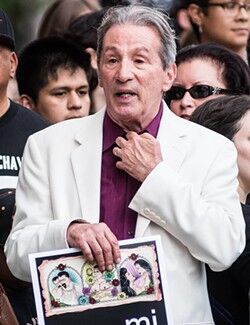
That kind of tactical division was on former state Assemblyman Tom Ammiano's mind when he arrived midway through the hearing to deliver a Cassandra-like warning to would-be reformers. “Sacramento is like quicksand,” he cautioned.
Ammiano has been here before, having sponsored a bill similar to Ting's that, according to him, died when the Service Employees International Union pulled its support at the last minute.
Perhaps the worst argument for leaving Prop. 13 as is came from Kirk Stark, a professor of tax law and policy at UCLA Law School. Stark said he “would be personally devastated if Prop. 13 were appealed.” Why? He'd have to completely revamp his syllabus.